
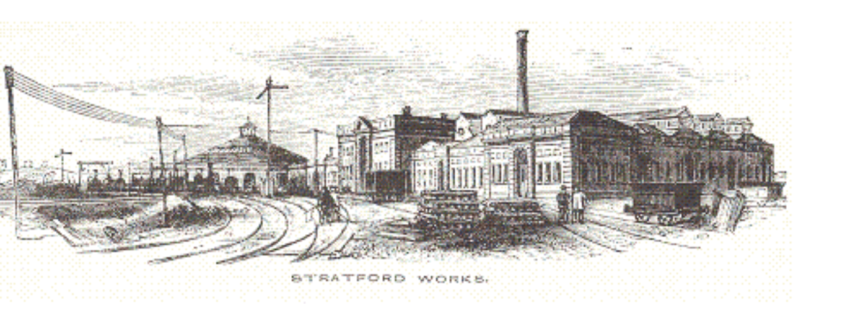
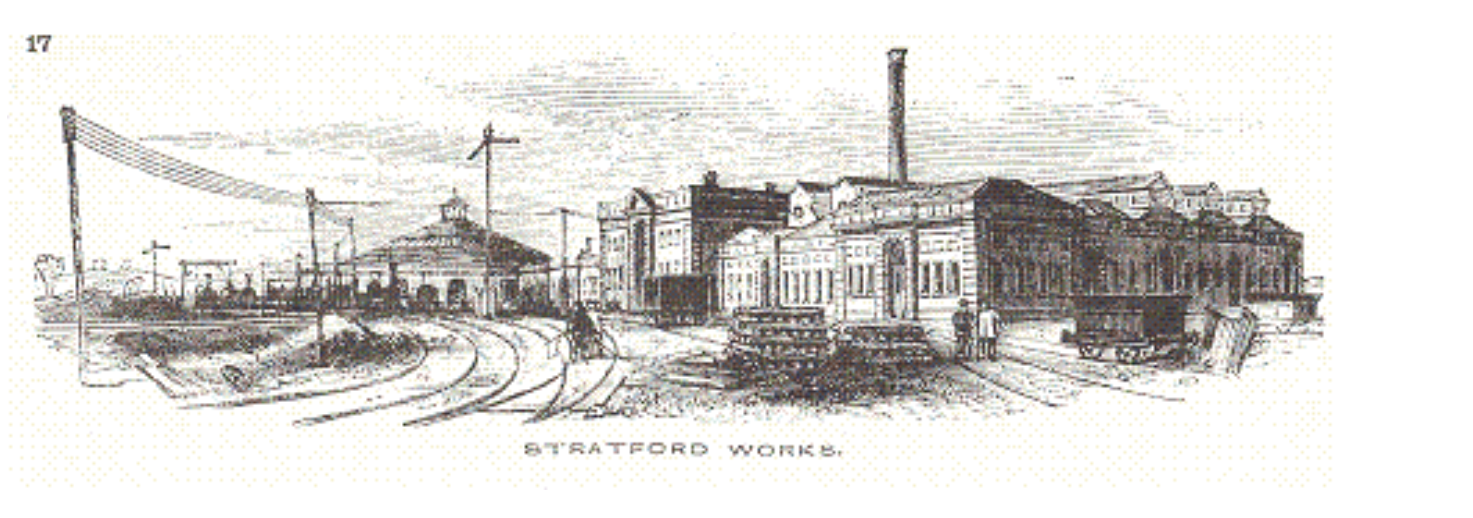
Built in 1847 by George Hudson, known as the “Railway King”, Stratford Railway Works was accompanied by a purpose-built settlement for employees called “Hudson’s Town”[cite: 1]. Over its 151 years of operation, the works produced 1,682 locomotives, 5,500 passenger vehicles, and more than 33,000 goods wagons[cite: 1]. In 1862, Stratford’s railway workers also founded the Stratford Co-operative Society, which later became part of the successful London Co-operative Society[cite: 1].
The arrival of the Northern and Eastern Railway in Stratford and Broxbourne in 1840 helped drive the Lea Valley’s industrial growth northwards[cite: 1]. Large housing developments, including the Warner Estate in Walthamstow, soon followed as the population rose sharply[cite: 1]. Between 1851 and 1911, the populations of Leyton and Walthamstow each grew by 120,000[cite: 1].
Stratford Works in East London became home to several notable engineers and superintendents who introduced important technical innovations[cite: 1]. It also remained in operation for more than 151 years, a world record[cite: 1]. One such superintendent was James Holden, known for building the world’s most powerful steam locomotive, the 0-10-0 Decapod, and Britain’s first oil-fired steam locomotive, Petrolea[cite: 1].
Competition between railway companies was intense, with each seeking to outdo the others[cite: 1]. In 1888, Crewe Works of the London and North-Western Railway built an 0-6-0 locomotive in 25 and a half hours, setting a British record[cite: 1]. In response, Holden cut the build time to 9 hours and 47 minutes in December 1891, a record that still stands worldwide[cite: 1]. He also had the engine painted grey and sent straight into service[cite: 1]. Even more remarkably, the locomotive ran for about 36,000 miles before returning for repainting and servicing[cite: 1]. After 43 years of service and 1,127,750 miles, it was scrapped in 1935[cite: 1]. Today, nothing remains of the works George Hudson established in 1847[cite: 1]. Stratford railway works was at one time the largest works and shed in Britain[cite: 1]. The original station, works, and the town George Hudson created have disappeared, replaced by a modern station, Westfields shopping centre, and the 2012 Olympic Games site[cite: 1].
