Establishment and Early Years
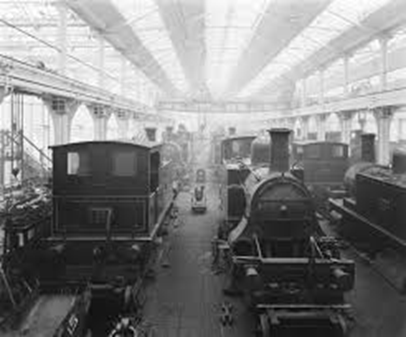
The North London Railway, although a relatively small railway, was distinctive in having its own locomotive works located
at Bow. The first locomotives were built at Bow in 1853, marking the beginning of a long history of locomotive
construction. From 1863, the works operated under the direction of William Adams, who oversaw the manufacture of
locomotives, carriages, wagons, and signalling equipment.
Expansion and Innovations
In 1882, a new erecting shop was constructed, managed by Adams’ successor, J.C. Park. Under Park’s leadership, the
works continued to produce 4-4-0 and 0-6-0 tank engines for the railway. At its peak, the workshops employed 750 men.
Between 1879 and 1901, thirty 0-6-0 tank engines designed by J.C. Park were built, with fourteen of these enduring into
British Railways ownership. The first locomotive completed at Bow was the 4-4-0 No. 43, featuring the Adams bogie
design to improve stability at high speeds. The last steam locomotive built at Bow was 4-4-0T No. 4 in 1906.
Production and Technical Achievements
Over 1,800 locomotives were constructed at Bow, along with numerous carriages and wagons. In 1860, the company
introduced the first installation of interlocked points and signals, enhancing railway safety. Two years later, in 1862, gas
lighting was installed in the carriages for the first time.
Mergers and Later Developments
In 1908, the North London Railway merged with the London and North Western Railway, and the works’ operations
became focused solely on locomotive construction. By 1923, the London and North Western Railway had become part of
the London Midland Railway. At this time, Bow Works was recognised as the best equipped among all London Midland
Railway works. In 1927, it also became responsible for repairing locomotives from the London, Tilbury and Southend
Railway, following the closure of their repair facilities at Plaistow.
Technological Advancements and Wartime ImpactIn the 1930s, Bow Works developed and manufactured the Hudd automatic train warning system for the London Tilbury
and Southend Railway. This innovation paved the way for a British Railways team to establish its headquarters at Bow,
where they worked on developing the British Railways Automatic Warning System, a safety feature still in use today.
During the Second World War, the workshops suffered significant damage during the Blitz, with the wagon workshop
being completely destroyed.
Diesel Era and Closure
In 1956, the workshop began repairing diesel-electric locomotives for the nearby motive power depot at Devon’s Road,
which became Britain’s first all-diesel depot in 1957. The works eventually closed in 1960, with diesel locomotive repairs
transferred to Derby Works.