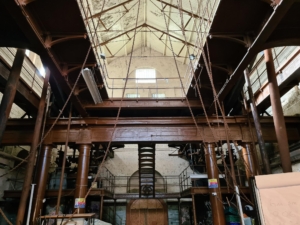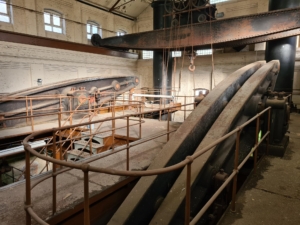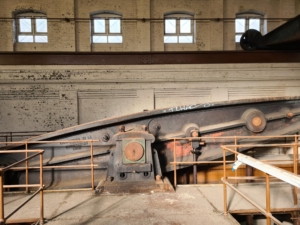
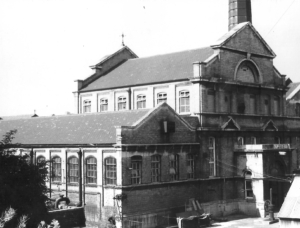
This site contains two large derelict Woolf compound beam engines built by Lilleshall of Oakengates in Shropshire in 1895-1900 which were used to lift untreated sewage from the low-lying areas of West Ham in east London, directly into the adjacent Northern outfall sewer running from the Thames embankment eastwards passing Abbey Mills pumping station and then onto the Barking (Beckton) sewage treatment works.
The site was constructed in 1897 by the County Borough of West Ham as a combined sewage pumping and electrical generating station housing nine Lancashire boilers 30 feet long x 7’ 6” diameter later fitted with Benniss stokers, two inverted compound centrifugal stormwater pumps by Cochrane’s of 1900 of 20 and 33“bore x 24” stroke and a third similar by maker unknown removed from Canning Town Sewage Pumping Station. This pumped stormwater directly into the Channel Sea River.
Nothing is currently known of the substantial generating plant or its use, as it was removed fairly early on as local electricity demand increased. The engine room was later converted to workshops.
In operation, a beam engine was typically kept running 24 hours per day, carrying the station’s base load, with the other five engines on standby or under maintenance. In storm conditions, all five engines could be run at once.
The site also contained blacksmith and general workshops, offices, an underground coal store and a conveyor system with a wharf for coal barges delivering via the Thames and River Lea.
It served the local community faithfully for many years until closure, when at 1200 noon on 10th January 1972, the No 2 beam engine was finally shut down, being replaced as a result of sewer diversion works and new electric pumps added at other sites. By now, these were the last sewage pumping beam engines in daily service in the world.
Still under the control of the Borough of West Ham, it was transferred to the Greater London Council (and later Thames Water), who converted the site to a sewer maintenance depot. The Lancashire boilers and Cochrane storm water engines were scrapped and the spaces transformed into garages, workshops and stores. The unknown stormwater engine was removed for preservation by the GLC and given to the London Graving Dock, whose apprentices installed it in the boiler house of the Tilbury Jetty. Its current location is unknown, but it has presumably been scrapped. Apart from a coat of paint, the beam engines have sat unloved ever since.
In 1972 the entire site was closed and after a period of dereliction, squatters and metal thieves gaining access it was put up for sale by Thames Water and purchased by ALPHA Ltd, a construction and gas engineering educational/training school that then went on to renovate the buildings and convert them to training workshops for adult education and apprentices and a church community centre. The training school and church have been a success. Whilst there had always been an aspiration to try and do something with the engines and buildings in terms of heritage and public access, the run-down nature of the area, being in one of the most deprived parts of London, prevented this. Several investigations were made to obtain funding, but without success until today.