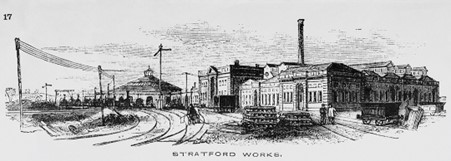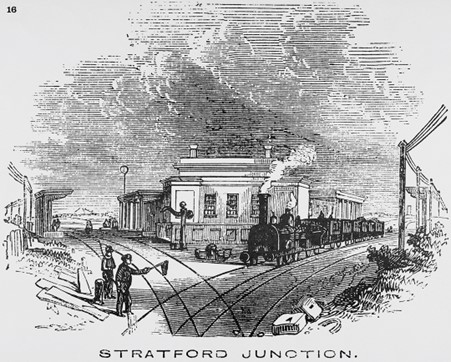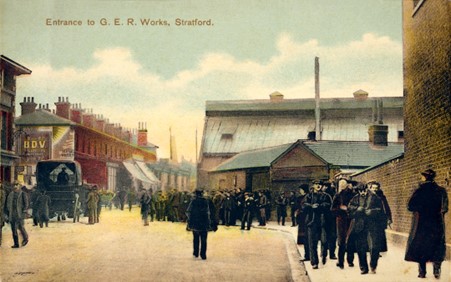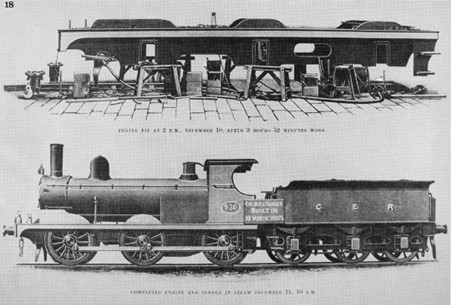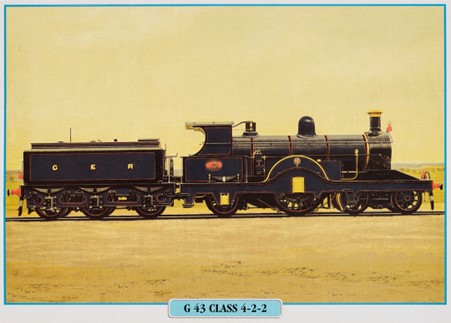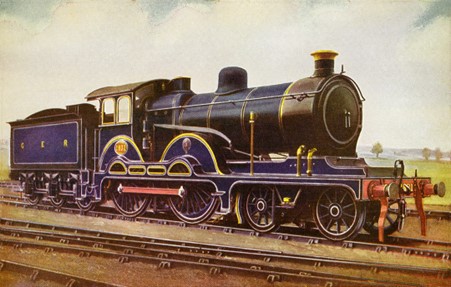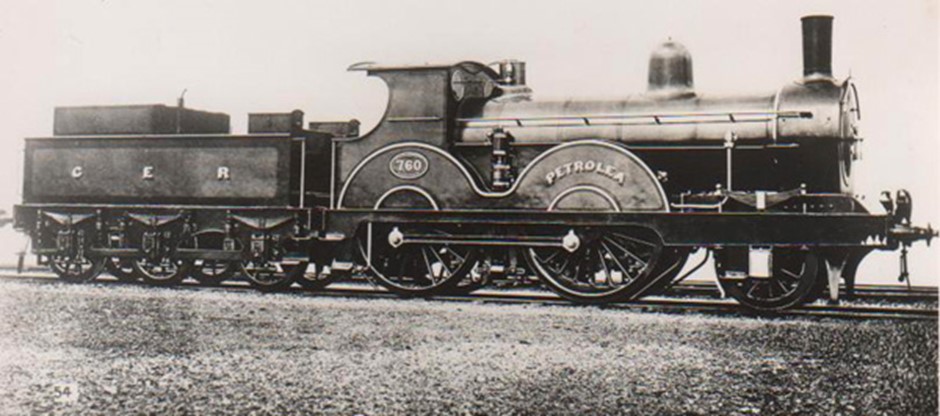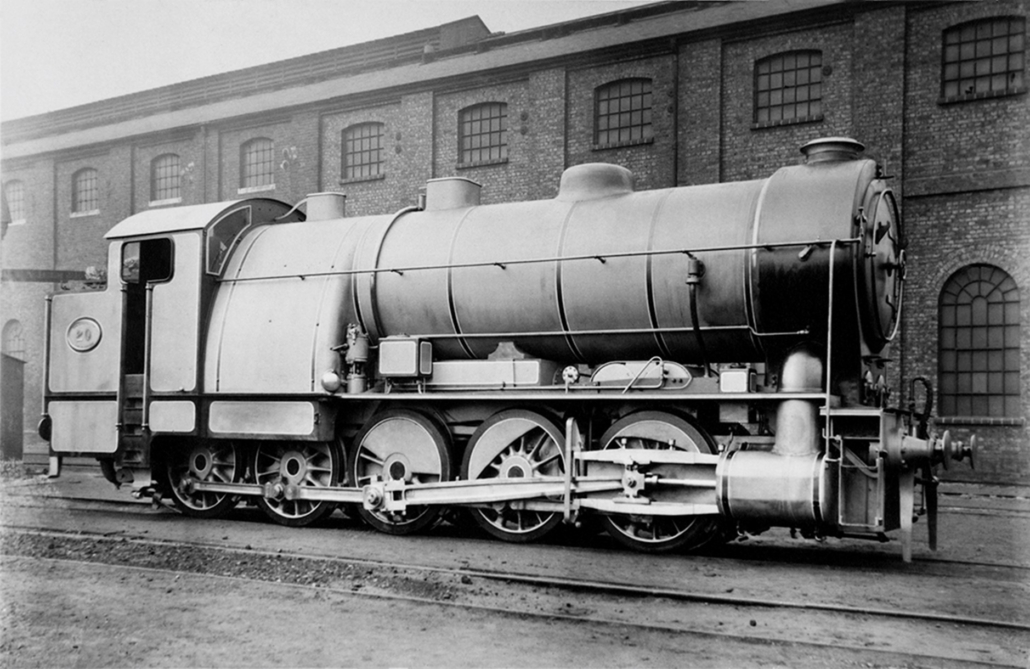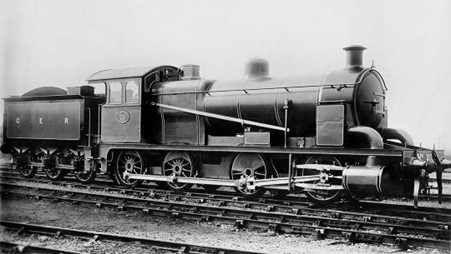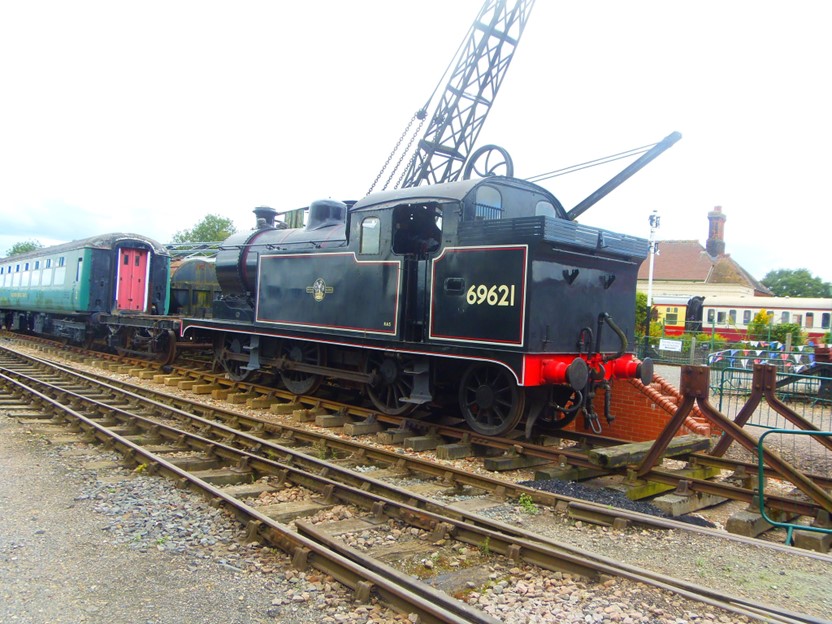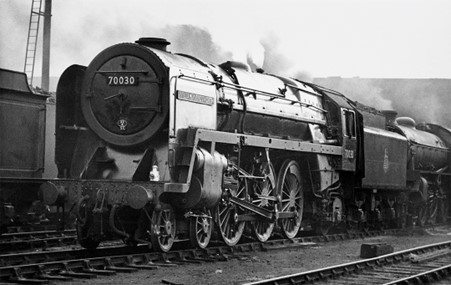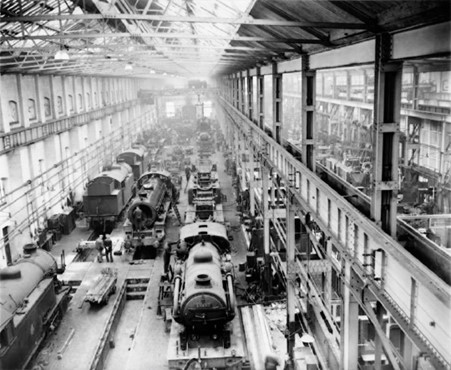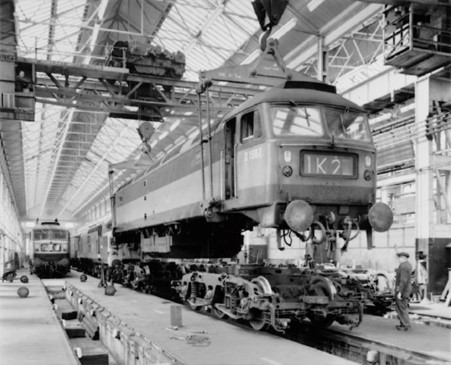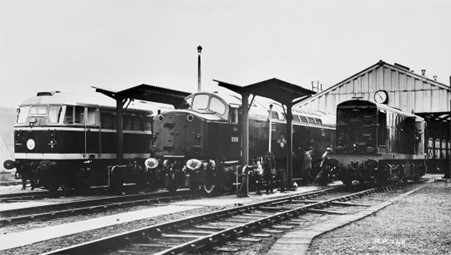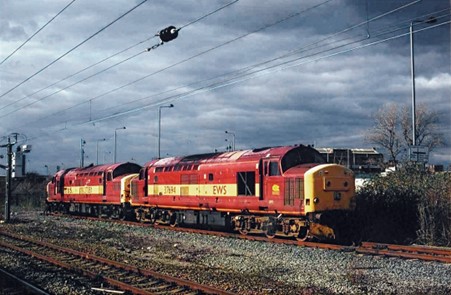
The history of Stratford Railway works starts with a small railway works and roundhouse, built by the Northern & Eastern Railway, existed at Stratford in 1840. However, in 1847 the Eastern Counties Railway, then under the chairmanship of George Hudson, built a new and much larger works. Hudson was known as the ‘Railway King’ because of his extensive involvement in railway development all over the country. The new Stratford Works would become something of an industrial landmark and to attract and retain skilled workers 300 houses were built locally in a district which became known as Hudson’s Town. Over the years the works acquired an impressive record of building not only locomotives but also rolling stock and road vehicles. It was for a time the largest railway works in the country. The Eastern Counties Railway, along with the Northern & Eastern Railway, were absorbed into the Great Eastern Railway in 1862. The G.E.R. then took over control of Stratford Works and expanded it. Between 1870 and 1900 around 960 engines were built, including a Class Y14 0-6-0 locomotive which was constructed in a record breaking 9 hours 47 minutes. In 1923 the G.E.R. was in turn absorbed into the London & North Eastern Railway, one of the ‘Big Four’ railway companies, and Stratford became the main works for the whole of East Anglia. James Holden was appointed Locomotive Superintendent to the Great Eastern Railway in 1885 and so took charge of the Stratford Works. He set about reorganising it and introduced a high degree of standardisation that made Stratford exceptional in the speed and efficiency of its locomotive production. Holden introduced improvements to existing locomotive types and introduced several new ones, including the T19 Class of 2-4-2 express passenger engines which became the mainstay of Great Eastern main line passenger services and the Class R24 0-6-0 tank locomotives which in the 1890s took over the whole of the suburban working between Liverpool Street and Chingford, Enfield Town, and Palace Gates. Holden first introduced oil burning in stationary boilers at Stratford Works. He then proceeded to build oil-fired locomotives for suburban passenger use which burned waste oil previously discharged into the River Lea. Two cylindrical tanks were mounted on top of the tenders of these engines to hold the fuel oil, and in recognition of this modification Holden named the locomotive No. 760 ‘Petrolea’. The ‘Decapod’ was an attempt by Holden to develop a steam engine that could perform to the same level as an electric locomotive. Built in 1902, it had a massive boiler, a very wide firebox, three cylinders and 10 small driven wheels that enabled it to accelerate to 30 mph in under 30 seconds. It proved a point but, it was too impractical to see regular use and so remained an intriguing one-off. The ‘Decapod’ was rebuilt in 1906 and converted into an 0-8-0 freight tender locomotive. However, it proved to be no better than existing freight engines and so the design was not repeated. By 1862 Stratford Works was greatly expanded to become the largest depot on the Great Eastern system. In 1920 there were 550 locomotives allocated to Stratford depot (including sub-sheds at Walthamstow, Enfield, Chelmsford, Epping, Ilford and Brentwood) and in 1923, when the G.E.R. was incorporated into the London & North Eastern Railway, the depot was further developed to accommodate larger locomotives such as the L.N.E.R.’s new B1 4-6-0 express passenger engines. The last engine to be built at Stratford was an N7 class of locomotive 69621. Following nationalisation of the railways in 1948, Stratford continued to be an important depot for the Eastern Region of British Railways and a new diesel shed was opened in the late 1950s, though steam locomotives continued to dominate the depot well into the 1960s. With the electrification of both mainline and suburban routes in the Eastern Region during the 1980s, Stratford declined in importance. Having survived the privatisation of the railways, in 1994 the works was taken over by English Welsh & Scottish Railway company, but the works was finally closed in 1997. During the early 21st century all vestiges of the depot were obliterated when the site was comprehensively redeveloped to create Stratford International Station and the Westfield Shopping Centre.