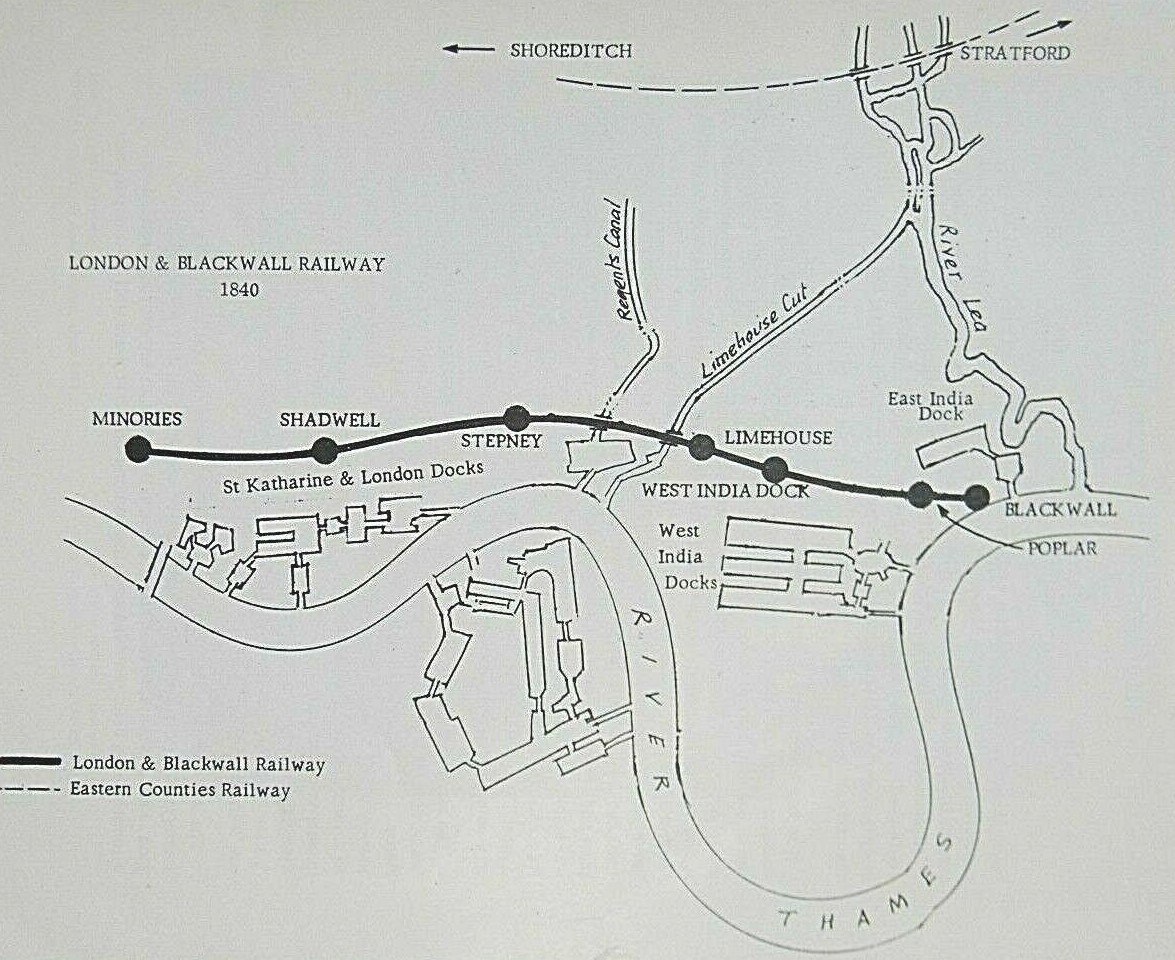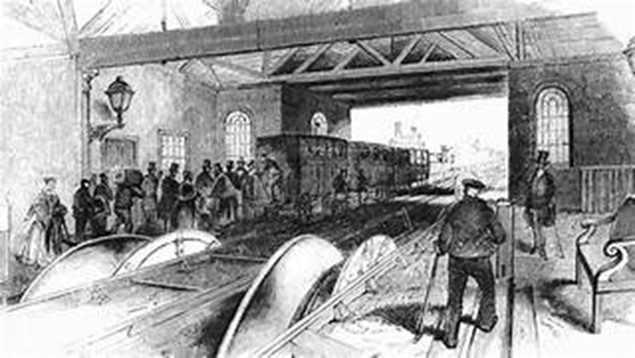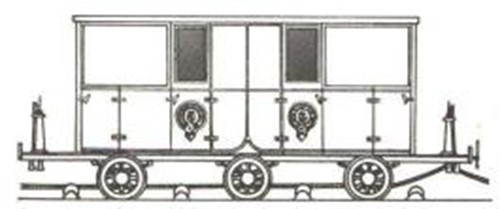
On the 4th of July in 1840 a cable railway was opened between the Minories in the City of London and Blackwall which was at that time London’s Port. The engineer William Cubitt constructed the line. The Lord Mayor of London rode in the first train. This was extended to Fenchurch Street in 1851. The railway was called the London and Blackwall Railway which was operated and managed by the company of the same name. The original name of the railway was the Commercial Railway. The railway also owned 3 paddle steamers which operated from the new Gravesend Pier. It was a fully operated cable (Ropes) railway with carriages being able to be pulled in both directions. The carriages were 6 wheeled and between 18ft and 20ft in length with an ornate for 1st class compartment but more like cattle vans in the second class. The trains were operated a series of slip coaches which when approaching the next station, the back coach would detach itself from the set of coaches and the rope and glide to the intermediate station and remain there until the return journey when they would be collected by the main train back to the terminus. The lead carriage would collect the carriages at each intermediate station on their way to the terminus. This had the advantage of not requiring the rope to stop but the disadvantage that you could not travel between intermediate stations. The gauge of the railway was a little over 5 feet. Engine houses were built at each end of the line to house two steams engines at both locations to pull the cables. The steam engines were sited at the Minories end were built by Maudslay Sons & Field and at the Blackwall end by Barnes & Miller. The circumference of the rope was five- and three-quarter inches which snapped easily and was replaced by a metal cable. The fare for riding on the railway after several changes was set four pence which gave the name of the railway as the Fourpenny Rope. The railway was equipped with an early telegraph system designed by Cooke and Wheatstone to tell each end of the line when it was ready to take a train. In 1850 the railways changed to steam engine operations. The gauge of the railway was then reverted to the standard gauge of four feet eight and a half inches. The Blackwall railway was taken over in 1854 by the London Tilbury and Southend Railway with a joint venture between the London and Blackwall Railway and the Great Eastern Railway. In 1926 The London and Blackwall Railway effectively closed after the cessation of passenger services.