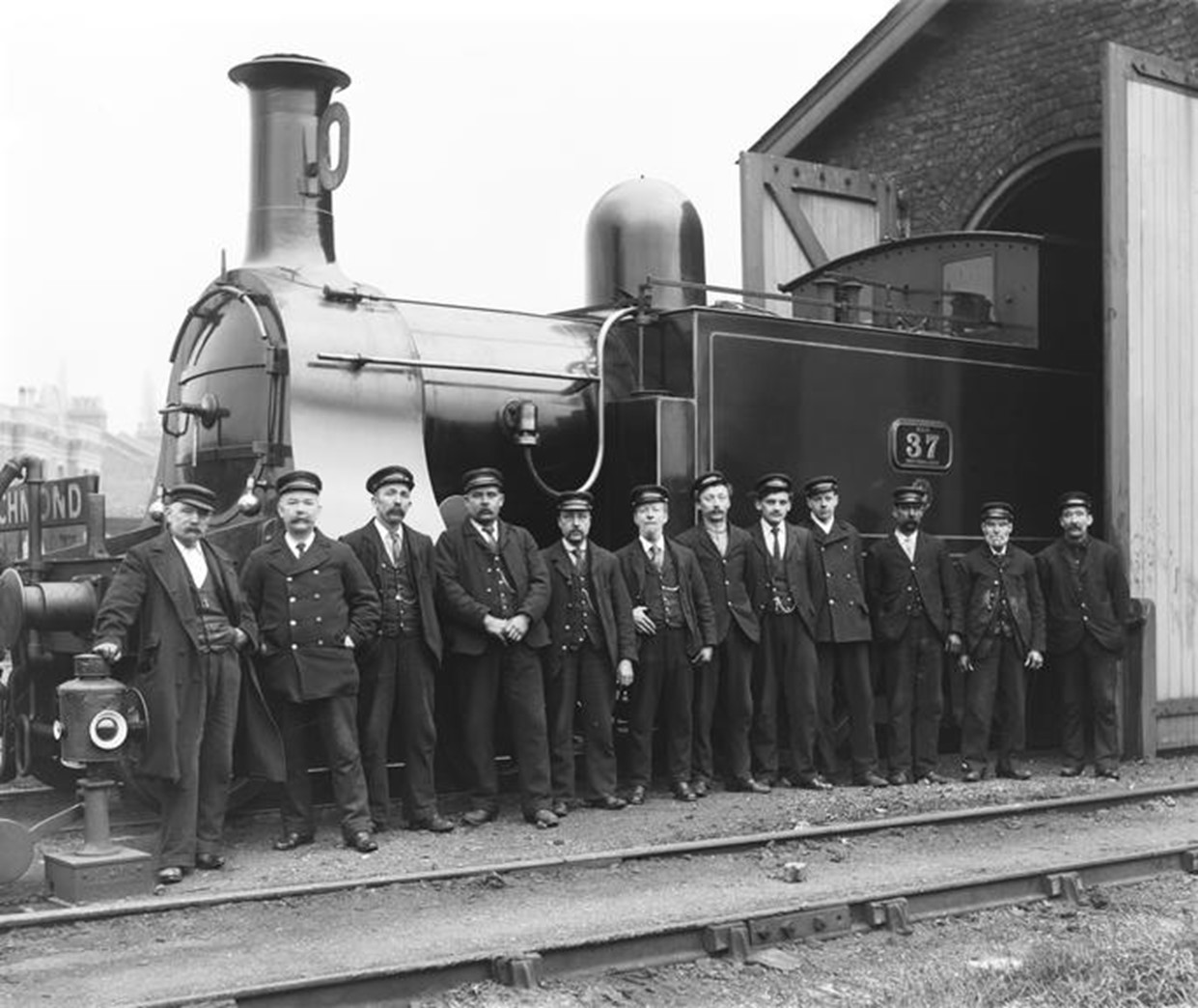
Unusually for such a small railway the North London Railway had its own works at Bow. In 1853 the first locomotives were built at Bow and from 1863 they were built under the direction of William Adams. The works during its operation constructed locomotives, carriages, wagons, and signaling equipment. In 1882 a new erecting shop was constructed under the control of William Adams successor J.C. Park, who continued producing 4-4-0 and 0-6-0 tank engines for the railway. At its height the workshops were employing 750 men. Between 1879 and 1901 thirty 0-6-0 tanks designed by J.C. Park were built of which fourteen of them lasting into British Railways ownership. ‘The first locomotive completed was 4-4-0 No. 43 which incorporated the Adams bogie design to improve high-speed stability. The last steam locomotive to be built at Bow was 4-4-0T No. 4 in 1906. Over 1800 locomotives were constructed at Bow along with numerous carriages and wagons. In 1860 the company constructed the first installation of interlocked points and signals. And in 1862 is also instilled the first gas lighting in its carriages.1908 saw the North London Railway merged with the London and North Western Railway when the works just reverted to a locomotive works only. In 1923 the London and North Western Railway became part of the London Midland Railway. Bow works was at that time the best equipped of all the London Midland Railways works which then which became also responsible in 1927 for repairs for locomotives from the London Tilbury and Southend Railway when their repair facilities at Plaistow closed. In the 1930s the works developed and manufactured the Hudd automatic train warning system for the London Tilbury and Southend Railway which later led to a British Railways team setting up its Head Quarters at Bow to develop the British Railways Automatic Warning System still used today in all of its trains. During the second world war the workshop was badly damaged during the blitz and the wagon workshop was complete destroyed. In 1956 the workshop began repairing diesel-electric locomotives for the nearby motive power depot at Devon’s Road which in 1957 became Britain’s first all diesel depot. The works finally closed in 1960 when diesel locomotive repairs were transferred to Derby Works.